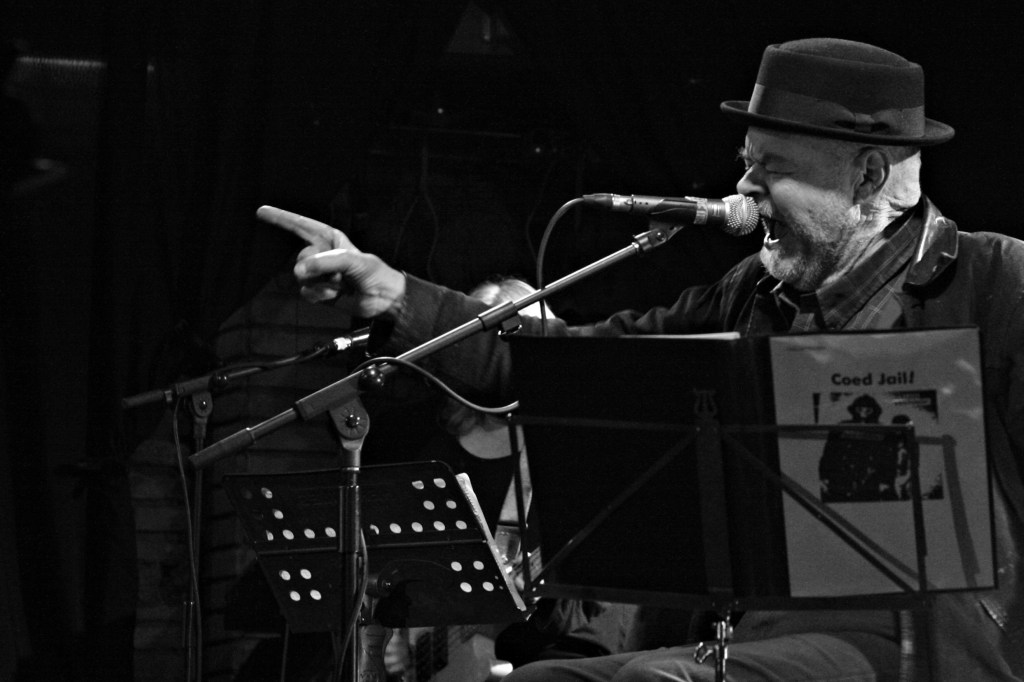
This last week has seen the death of David Thomas, best known as founder and singer of Pere Ubu, but also part of any number of collaborations. I could tell you why he’s great, but that would be a VERY long post and anyone can do that. A lot of people are doing that. As an artist and a thinker, he is one of the core figures that has shaped how I think about art and life and America. We shared a birthday, and we both emigrated from the US. The tributes are appearing now, and I am not sure what I might add, except some thoughts on what it means to reach the end of this life now. As I’ll explain, perhaps more than any other artist I know of, David Thomas has been confronting us with the end of the road generally, and his own death particularly, for decades. Back in 2016, the band already published how it would deal with his death. He already died twice in 2019. This was always coming. Now where are we?
we know…
On the title track to Pere Ubu’s second album Dub Housing (1978), the ‘dub track’ is a chorus of ghostly voices singing ‘we knowwww’. It’s the voice of the eponymous houses bearing witness to the future they were meant to project. And if there is a recurring theme in David Thomas’s oeuvre, it is this being haunted by what you know. It’s the past that won’t go away, but more importantly the future that you will come to know as inevitable. Even the upbeat “Bus Called Happiness” (1989) is an odd frame tale in future-perfect tense (“One day I’ll say: ‘I woke up to find a heap of a mess. Running for the bus, I cried “hold that bus! That’s happiness!”‘”) Greil Marcus highlights Thomas’s propensity for prophecy (alongside David Lynch, Philip Roth, and Sleater-Kinney) in his deeply insightful analysis of American culture The Shape of Things to Come: Prophecy and the American Voice. In the book Marcus sketches out the recurring theme in American culture that is both the embrace of the great hope of America and fear that it was always damned from the start. It’s hard not to read US’s current descent into fascism through this lens: it is both driven in part by a feverish desire not to face the reckoning of America’s enduring racial oppression, and is itself the damnation we thought we could avoid. We knowwww.
At a moment when other bands might have been touring a set of their back catalogue to aging nostalgists, the last time I saw them in 2019, Pere Ubu were performing mostly their latest disc The Long Goodbye, which was a lengthy rumination on Raymond Chandler, and not least the novel from which it takes its name, which Chandler wrote while he wife was dying. The album came out after Thomas himself had actually technically died twice, and as it states in the release notes:
David Thomas has been talking about Pere Ubu’s journey on the road that passes Satisfied City for many years but he has now declared that they have arrived at the end. […] Mr Thomas says “This wraps up every song and story that Pere Ubu has been telling in different ways for the past forty plus years. It is one definitive hour that provides the answers to the questions we’ve been asking and delivers it up into what I consider the definitive destination.”
And what destination?
Bay City
During the show, Thomas talked in particular about Chandler’s topos of Bay City, the pitiless and deeply corrupt city on the California coast that features in a number of his novels. This was brought in relation to the Westward flow of American expansion and the closing of the frontier at the ocean in the album’s long recitation The Road Ahead narrating the journey via car and airwaves westward from Pennsylvania. Bay City is where the road of America ends in the song’s closing section:
On the other side of every desert is Bay City
Which sits at the end of the road
At the farthest reach of the last straining lunge forward
Of an exhausted dream
At the end of the line
For every Free Citizen of the Future Passive Conditional
Where the irresistible westward urge
Collides with the immovable Pacific Object
And loses[…]
After the test
After the epiphany
After the vision
The revelation and the satori
The end of the road is
And always has been
Bay City
Where all travelers must come to a Separate Peace
Or be swallowed up
And here we are.
Take it a while, a while to be there
I don’t want to end there. I need to tell you about what it was to see David Thomas perform. I first saw David Thomas with Pere Ubu in Atlanta during my last year at college in the Spring 1993 and then at least half a dozen times with Pale Boys or Pere Ubu over the decades until that last time in Rotterdam in the autumn of 2019. Every single show was revelatory in ways that video never captures. At one point in that first show I saw, he fished around in a box of random stuff on stage and came out with a cold chisel and water tap and began to beat the one with the other along with the song. I can’t remember which song it was, but it was the sight and sound of a lost man grasping for anything solid around him as a reassurance he was alive. As the song moved toward to its increasing sonic meltdown, Thomas stepped away from the mic, but kept speaking, the words becoming lost as the cold chisel kept pounding, until he held it out to the audience like an offering or a prayer that would forever be unintelligible.
You had to be there.
In some ways, I’m still there.
People often focus on his hulking stage presence: the bloated, frustrated spirit of Ralph Cramden or indeed an Ubu Roi. That’s important but it misses the time vector that runs through all of Ubu’s work. Some moments and places loom and loop eternally until they are – or always were – hallucinations (‘I like to speak from other places that don’t еxist’). Several songs feature the same lines, and the same places. But when he conjured these moments, it was always against the backdrop of time and its relentless movement. In ‘SAD.TXT‘ (1998) he sings to the young woman who will never love him ‘time will catch up to you. Like it caught me, too’. On stage his own bodily decay was the witness to the vector of time. It leant the shows something frankly Shakespearean, where the act and the real collide. Mercutio dying while his friends think it’s a joke. Lear’s madness until he says “I know you. You are Gloucester” when it’s the greatest gift and far too little and far too late. People go to see Springsteen or the Stones to marvel at the ways in which they still have it in spite of age. David Thomas looked you in the eye and showed you what aging and losing was. The fat man with the rubber apron and accordion singing “Surfer Girl” dared you to laugh.
On “Road is a Preacher” (2019) time comes: “It’s time that I am gone/Can I get a witness?”And in writing this I realise, though I have not yet fully worked out its implications: seeing David Thomas perform, you weren’t an audience or a spectator. Because one isn’t audience or spectator to prophecy. You’re a witness. As Raymond Chandler could tell you, that’s a much more dangerous thing to be. When you’ve witnessed, you can no longer safely say you didn’t know.
Time comes, you’ve got to face what you know.



 Alec Badenoch
Leave a comment